Showing posts with label chickens. Show all posts

Thursday, July 10, 2008

The size of things

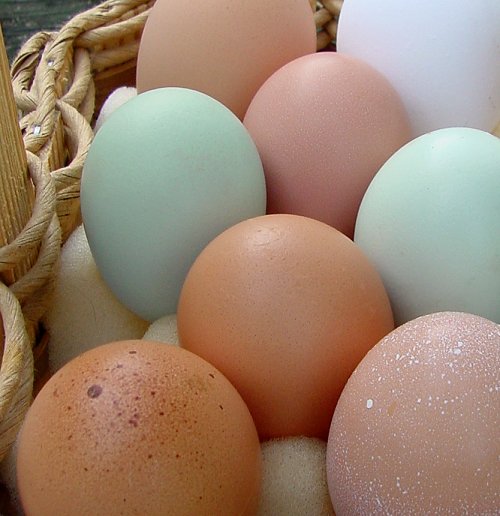
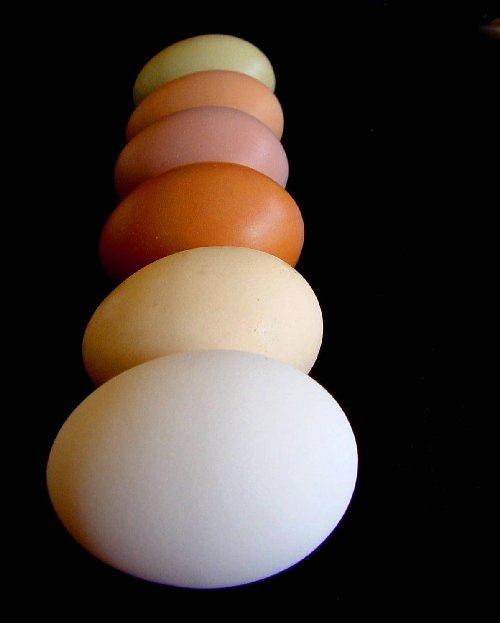
When we had 20+ chickens, it was often impossible to tell who was laying what. I never was sure which individual was laying the pinkies in the egg picture above (in the the new header)1.

When you only have two chickens, it's easy to tell the difference in the eggs.


On the left is an egg from the Marans hen. They're supposed to be very dark eggs, but sometimes they turn out speckled. You don't find chickens advertised as laying spotted eggs, but most of our hatchery Marans did, from time to time.

On the right is an egg from the Easter Egger. They are usually green or blue. This one is such a pale green that it didn't come through well in the photo.

Common wisdom has it that chickens lay fewer, but larger, eggs as they age. I've found that to be true for all the types we've had except the Marans. Hers continue to be smallish, but she's laying more often now than ever. All our chickens' eggs have gotten lighter in color each successive season.

-----

1That seems to be the picture that people remember most from the blog. (Every time I look at it, it bothers me that I didn't get them lined up a little straighter.) It was from my first month of blogging, so I suppose you could say it's been all downhill from there. Click here for the larger, right-side-up original version.

Tuesday, June 24, 2008

Why don't we do it in the woods?


Aha!


No wonder we weren't getting any eggs.

We had an idea that this was happening. We kept hearing that chicken-laying clucking noise far from the coop. That cliché you always hear about hen talk? Buck-buck-buck-buckAH! That's how it really sounds. I keep thinking that it's the poultry equivalent of "Ow! Ow! Ow! This really hurts!" But I'm probably just imagining things.

I'd tried to investigate earlier, but that thicket has a poison-ivy carpet and is packed with those mid-level leafy shrubs that ticks love. I had on shorts and no hat, and I'm a little wimpy about that kind of thing, so I didn't get far. Hubby found it later, underneath a brush pile, a lot closer to the edge of the field than I'd thought.

Hubby removed these eggs, and put fresh straw in the coop's laying areas. Success! The Easter Egger found it suitable and laid an egg there yesterday. Since she was the instigator of this little revolt, I'm hoping the Marans will follow suit.

Wednesday, May 14, 2008

Dumpling


"You need to get more chickens," my sister told me. "I miss the Chicken Chronicles!"

Somehow we still haven't managed to get any more chicks this spring, though we had intended to. We have only two hens, an Easter Egger and a Marans.

The Marans (named "Dumpling", shown here), bucking common chicken wisdom, is laying more often now that she's older. She lays an egg almost every day. The Easter Egger (Americauna) is a slacker. Her eggs are larger, but we're lucky if she graces us with two a week. And they've lost their pretty green and blue hues, fading to practically white. Maybe she's just tired.

The number of eggs from two chickens is really more than enough for just the two if us. But a whole flock is fun to watch, plus they keep the yard free of ticks (if you can keep them out of the woods long enough). Stay tuned... we may yet get a few more this spring.

Monday, May 21, 2007

Stop thief!


Red-winged Blackbird (Agelaius phoeniceus)

Chicken food thief!

Actually I don't begrudge the blackbirds or grackles a little chicken feed. But I have started to wonder about the possibility of melamine in the layer ration.

Saturday, April 07, 2007

Last Leg

We lost our last White Leghorn yesterday. At just over three years old, she was our longest-lived chicken, and the last hen from the original flock. She never came back to roost at night, and was presumably a meal for a predator with babies to feed.

I looked up every synonym for sad, but couldn't find a word to explain the feeling I had when I opened an egg carton and saw her white eggs still in there.


Catbox stuffing, in better days.

Wednesday, March 28, 2007

Spring chickens


It doesn't really take much to have a chicken fan club.


Before you know it they'll be eating out of your hand.


Chicken dance lines involve a bit more training.

-----


Why do you think they call it henbit?


A mouse does not make a good pen.


Once more, from the top


"Sure, they're both European invaders, but the flowers taste really good to chickens. And the square stems are pretty cool too."

-----

Submitted to the Friday Ark.

Tuesday, March 27, 2007

Springtime

Local weather seems fixed on skipping straight to early summer. I'm in t-shirts and shorts and still sweating -- it's been in the mid-80s (30°C) already. News reports said we'd had the driest December - January - February period on record for over 100 years. It doesn't seem to have affected the wildflowers, though. And finding springs has never been easier: just walk into the woods and listen for frogs.

Hubby tilled up the garden. He mowed the grass for the first time, or part of it anyway -- he also experienced the traditional first bending of the lawn mower blade.

Tiny ants keep popping up in the kitchen, and outdoors the larger ones are unrelenting. Diatomaceous earth poured onto an ant superhighway only served to split them into two trails on either side; seemingly twice as many ants.

I happened upon my first migrant (Swainson's Thrush) when I was without binoculars, and had to practice a considerable amount of stealthy sneaking to confirm the ID. We've seen or heard several others since then: Louisiana Waterthrush, Northern Parula, Blue-gray Gnatcatcher, Black and White Warbler, Common Yellowthroat, Rough-winged Swallows, Broad-winged Hawk.

The chickens' and ducks' fancy has turned to love, or to mating at any rate. The female muscovy is trying to sit on eggs yet again, but that duck doesn't have a lick of sense so I'm not holding my breath. The chickens are laying very well, but the color of the eggs is lighter than last year. Sometimes the green/blue eggs are almost as pale as the white ones. Hens are supposed to lay fewer eggs every year, but larger ones. I don't think our Leghorn or Marans read that book though, because their eggs are smaller than last year.

-----

Edited to correct horrendous spelling error. I read once that the smarter you get, the worse your spelling becomes. It's probably not true, but I repeat it a lot anyway.

Wednesday, January 24, 2007

Easter Egger


I interrupt the series of garden tour photos for this picture of a chicken.

In comments, Ki suggested that we try Araucana chickens. I've looked into it, but they're expensive and difficult to find in the US. And even if you do, they'll most likely be Americanas instead, or Easter Eggers. Those we do have, and of all the chickens we've owned, they're my favorites.

We free-range our chickens, but even with a livestock guardian dog there's somewhat of a predator problem,


and the heavier chickens we've had (Dominiques, Buff Orpingtons, Marans) always seem the first to go. The lightest chickens (Rhode Island Reds, White Leghorns, and Lakenvelders) have also tended to be the flightiest, which is no fun when you're attempting to remove eggs from under them. (They freak out.) Easter Eggers are somewhere in the friendly but wary middle ground.

True Araucana chickens lay blue eggs, but they are difficult to breed. So hatcheries sell Easter Eggers (even if they call them something else), which usually lay green eggs, but sometimes blue or pink.

Two of our girls started out laying bluish eggs, but this year they're more greenish. (A particular chicken's egg color usually changes over time.)


It's OK though.


I like them all.

Saturday, January 20, 2007

By request: chicken coop

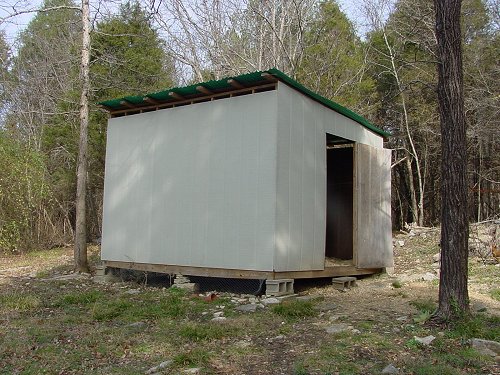
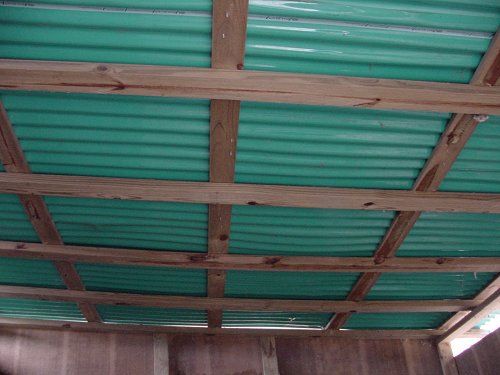
Someone asked about the details of our chicken coop. I'm sure you can probably build one more cheaply than hubby did, but here you go. Click on any of the pictures for a larger version.

Open yard in front, woods in the back. The chickens used to roam picturesquely around the yard, but nowdays they're in the woods most of the time. If we fenced around the coop we'd have fewer predator losses I'm sure.


The ground is rocky and slopes a little here.

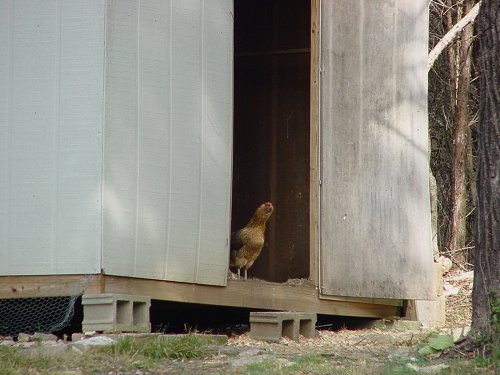
One of the Easter Eggers wonders what I'm up to. That cinderblock in front is really for me, but the chickens use it too. Hubby originally designed the back wall to have a door with a ramp for small chicks, but it turns out that they can hop up on the block too, so we never open the other side.
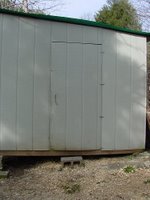

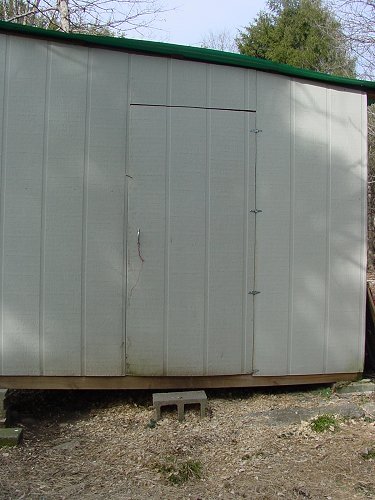
The door is person-sized rather than chicken-sized.
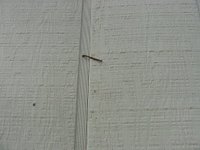

Fancy door lock #1 (closed door position). There's one at the top and another at the bottom.
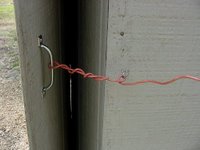

Fancy door lock #2 (open door position).
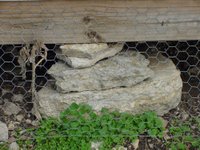

Fancy footing. Jasmine crawls under the coop at this end sometimes. Not that a little thunder would frighten her or anything... she just likes it under there.
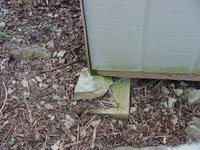

Hubby poured concrete for the corner footings. He says that he wishes he'd made a row of footings down the middle (underneath) too but it's a little late for that now.
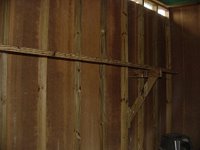

Left (front) side wall. We made two roosts on this side, one low and one high. They only ever use the high one though. Hubby went back and added some of these wall beams later because the side was bowing out a little. Whoever is the top-dog rooster usually roosts directly by the door on this side. No idea why! If you enlarge the picture, you can see that some of the chickens like to roost on that little support piece that's between the roost and the wall.
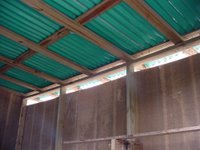

He's having the same problem with the back wall bowing, and says he needs to add beams here too. The roost is shorter on this side. When we had a lot more chickens, they'd divide up between sides. Nowdays they all roost on the same side, but usually divide up on either end!
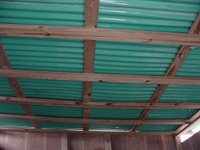

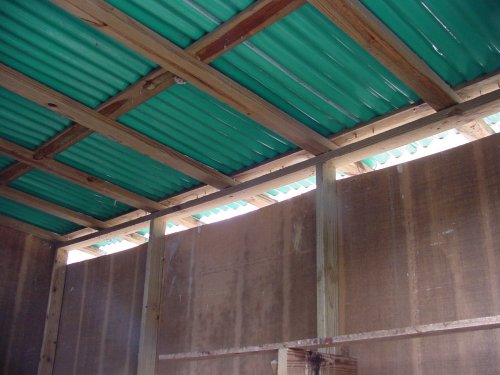
The roof slopes and has space for ventilation on both sides. I thought we might have trouble with critters getting in, but we've only had a problem once with a rat snake that ate several eggs and killed a pullet. The ventilation really helps in the summer and doesn't seem to hurt in the winter. (We are in zone 7 so this might not work in colder areas.)
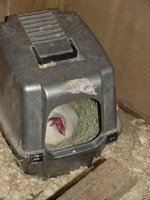

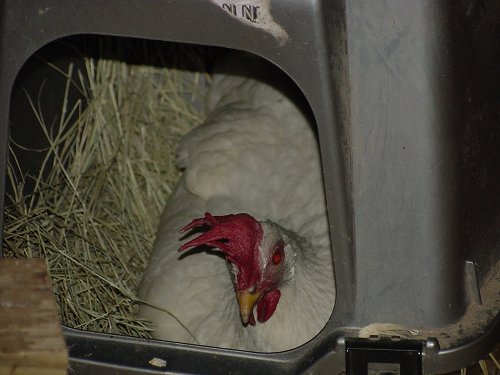
Here is the chickens' favorite nesting box. Yep it's a cat litter box. You can see a little piece of the never-used lower roost. I really need to remove it, since it's only good for banging up my shins.
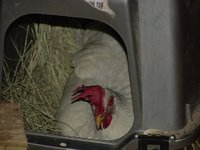

White leghorn tries to give me the evil eye. She is the oldest chicken we have left now -- in the spring she will be three years old. She still lays very consistently, although her eggs are smaller than they once were.

All the chickens have begun laying again. I wanted to get more chicks in the spring, but hubby is trying to talk me out of it. We have been eating fewer eggs, but I really like having chickens just for pets. And I'm afraid that if we begin the spring with only 6 hens, we'll have none left by fall. There's still time to think about it.

Tuesday, December 05, 2006

Chicken politics


The hens are on strike! We haven't had an egg in over a month. After they're a year old, most chickens molt and stop laying in the fall. I was under the impression that Easter Eggers laid all winter, but ours must have missed that memo.

This is the first year we haven't had spring chicks, so that's why it's a new problem. (Chicks born in the spring don't molt until their second fall.) My homesteading friends tell me that a light bulb in the coop will keep them laying, but for several reasons we don't want to do that.

So, no eggs for a while. We're hoarding the few we have remaining. (It's amazing how long real fresh eggs will last.)


After Stewpot disappeared, I wondered how the other roosters would behave. Both had been extremely submissive, and Stewpot had let them stay near the flock, as long as they didn't, umm, try stuff.

Big Red, the Rhode Island Red, decided he'd like to be the new boss. It worried me. He began acting aggressively, and though I had so far been able to bluff him into backing down, I feared we'd have to butcher him. An agressive rooster that large was NOT something I wanted to keep.

Then one afternoon we noticed Big Red wandering alone in the yard, past the time that the chickens normally put themselves to bed.


There had been a fight. He'd lost.

The dark spots on his comb are dried blood. I figured he was now blind in one eye too. Plus, there must have been injuries we couldn't see, since he sat in a dark corner of the coop and wouldn't eat or drink. I thought he might die.


But he improved. Now he's eating again -- he loved this treat of chicken scratch I brought him -- and even opens that eye now and then.


Meet the new boss. His name is Eagle.

Throwing out the previously liberal rooster-inclusion policies, Eagle has changed the rules. Big Red is not allowed to stay with the flock. I'm not sure how that is going to work out.


His comb's a little odd. I can't decide if it's a rose comb, pea comb, strawberry comb, or some combination.

But he'll eat out of my hand. He's a very sweet rooster. I just hope he stays that way.

Friday, October 13, 2006

R.I.P. Stewpot

How many times did I ask the coyotes why they didn't take a rooster instead of a hen?


They finally did. Stewpot failed to return home at the end of the day.

Despite all his meanness, I'm going to miss him. He was one of our first chickens, and he sure was handsome.


With his girls.


Dust bathing.

How he was named, and his antics.

Thursday, September 21, 2006

Egg without a shell


It may appear normal, but this duck egg is missing its shell and is covered only by a thin membrane.

Chickens lay eggs at any old time of day, but ducks are more organized: they almost always lay in the early morning. Sometimes if we let them out of the pen before normal, they're forced to lay eggs in the grass or other odd places. Like the porch.

Every now and then a chicken will lay an egg without a shell. It's usually when they first start laying that this happens -- as if all their parts aren't yet working correctly. But sometimes it occurs long after you'd think all their reproductive processes would be sorted out already.

I tried googling to find the cause, but mainly came up with, "It just happens sometimes." I hadn't noticed the ducks doing it too, until this egg.

As this page on Odd Eggs notes, when you pick it up, it feels like a water balloon.

-----

Half the fun of googling is finding the stuff that you didn't know you didn't know. For example I'd heard of century eggs (aka thousand-year-old eggs), and although they don't sound appetizing to me, I'd probably try one. Same with tea eggs. But Balut? Umm, no thanks.

Friday, August 18, 2006

Murphy's law of chickens

Given: In the beginning there are 30 or so free-range chickens, three of them male.

Given: There is a little predator problem.

Murphy's law of chickens:
By the time you get down to nine chickens, three of them will still be male.


All that's left of the next-to-last Marans.

Since the last chicken update in April, we've lost five more hens.

We have two chickens still left from our original batch (from spring 2004), Stewpot and a white leghorn hen.

The others are survivors from spring 2005:
1 Rhode Island Red rooster
1 Easter Egger rooster
1 Marans hen
3 Easter Egger hens

The Easter Egger hens are my favorites - they're sweet (and apparently more predator-proof) and they lay cool greenish-blue large eggs all year long. (They don't stop laying during the molt or during the winter like some breeds do.)

We decided that if we get more chicks next spring we'll have to build a run for them around the coop and stop the whole free-range idea, or at least limit its hours. These chickens are just too fond of the woods (a.k.a. coyote and bobcat central).

Let me know if you want a rooster.

Tuesday, April 18, 2006

Chicken update

Our last remaining Buff Orpington:


We didn't get new chicks this spring. If we don't have too many predator losses we really won't need them. But if the chickens start disappearing at the rate they did last spring, we'll be short on eggs for a while.

Why the coyotes/bobcats/hawks don't go after the roosters, I don't know. We've lost three chickens so far this spring - all hens. We're back to the too many roosters problem of last year.

I'm afraid I've spent too much time with them to use the previous solution. Our sweet Easter Egger rooster will eat out of my hand. Even the Rhode Island Red is nice, if a bit stand-offish. (Email me if you're local and want one of those two!)

Current chicken count:

Roosters:
1 mean Easter Egger, "Stewpot"
1 nice Easter Egger, "Eagle"
1 nice Rhode Island Red, "Big Red"

Hens:
1 White Leghorn
1 Buff Orpington
5 Easter Eggers
1 Dominique
3 Marans

I think that one of the hens is a Dominique. She may be a Marans instead - they look very much alike.

The Marans eggs are lightening over time, and are not all they're cracked up to be in the "really dark eggs" department. Also, they're smallish. But we do get a few speckled eggs from them, which is kind of cool.

The last Rhode Island Red hen got snatched a month or so ago. I guess I've finally stopped crying over missing chickens.

Thursday, February 02, 2006

Da birdz


This rather handsome fellow is called Big Red. I never in a million years would have purposely ordered a Rhode Island Red rooster, since they have a reputation for meanness and we already have enough of that.

We were supposed to just be fostering him and five RIR hens. But when we never got paid, we were stuck. (No good deed ever goes unpunished!) So far he's actually very sweet though.

Anyway, Big Red dropped in to tell you about Birdstock, the 16th edition of I and the Bird, that is hosted over at the Dharma Bums.

He also reminded me that I never posted a link to the last Circus of the Spineless. Sorry about that!

Wednesday, September 14, 2005

Achoo.

I brought home something unintended from the craft show: a bad cold.

I usually swear by Cold-Eeze. They are magic! For me, they can fend off colds altogether, but you have to use them early.

It hadn't rained in Stone Mountain lately, and I naively assumed that the reason I had a stuffy nose was due to all the dust I'd inhaled over the course of four days spent outdoors.

Until my throat started hurting and I got a fever. I really should have known better, especially considering that the same thing happened to me last year.

So since I feel too crummy to go out and take pictures, here's one from a few weeks ago, of some of the eggs from our chickens. I love it when we get speckled ones! Yesterday there was a decidedly beige one too.


I haven't slept well in several nights, but I did have a good dream... I dreamed that a lady came to the craft show and bought ALL the soap. I woke up and thought how great that would be. Then I fell back asleep and had the same dream again, except this time it was Stephen Duffy who bought all the soap. Cool.

Hubby has the same cold, only without the fever. As far as I know, he hasn't dreamed about any pop stars though.

Wednesday, August 24, 2005

Chicken update


It is with great sadness that I must report the loss of the final Ms. Lakenvelder.

You may remember her antics from the Proof that Chickens are Crazy post or the Chicken Chronicles. She and her sometimes cream-colored eggs will be missed.

In happier news, many of the pullets have started laying! (And just in time too, with only four of the older hens remaining.)

Aside from the white Leghorn egg in the upper right, these are all from the new chickens.


Looking at the size of the white egg, you can also see how much smaller these "pullet eggs" are.

What beautiful colors, though! It's a little hard to tell from this picture, but the Easter Eggers' eggs are actually blue or blue-green instead of the very green ones we had from the previous hens.

The darker brown eggs are from the Marans, and the lighter brown ones and pinkish one are from the Rhode Island Reds. There is more overlap here than I would have imagined though - I'm not sure who's laying the midrange brown eggs.

Here is a link to pictures of the young chicks when they'd just arrived in March. You may notice I'd said we were fostering the Rhode Island Reds for someone else. Well he never paid for them. Though I probably wouldn't have ordered them on my own, I like them a lot more than I would have suspected. I would not have paid extra to buy a rooster on purpose though.

Tuesday, July 26, 2005

We could be twins

I always dress like this when I'm feeding the chickens. (In "a demure Grace Kelly-inspired chiffon dress and cashmere cardigan". Not to mention high heels.)

And my house looks just like that too. Yeah, that's the ticket.

Hint to Madonna: They're gonna want more than you've got in that little bowl.

Monday, July 18, 2005

Marans start laying


I've been expecting our Rhode Island Reds to start laying any day now. But the Cuckoo Marans, at least one of them, beat them to it.

We got one small, rather scruffy looking egg on Saturday, then this still small, but beautifully smooth and glossy one on Sunday. (Shown here with eggs from a Dominique and a Leghorn for comparison.)

From what I'd read online, Marans don't normally lay until 6 - 8 months old, so this was a happy surprise.

The first eggs from early layers are usually small. My mother-in-law calls them "pullet eggs".

Marans eggs are dark. Eggs from hatchery chickens will probably not get as dark as some of the lovely pictures you can find on the internet (here in English and here in French), but they're still considerably darker than other brown eggs.

Marans are a quiet chicken, not flighty like Leghorns. Unfortunately this seems to mean that they get eaten by predators more often. Out of the ten Marans we ordered in the spring, we've only got five left.

Other people have told me that non-white egg layers follow a pattern: The eggs are not their darkest for the first few months. Then they develop more color, and are as dark as they'll ever be. The following year(s) the eggs are lighter in color.
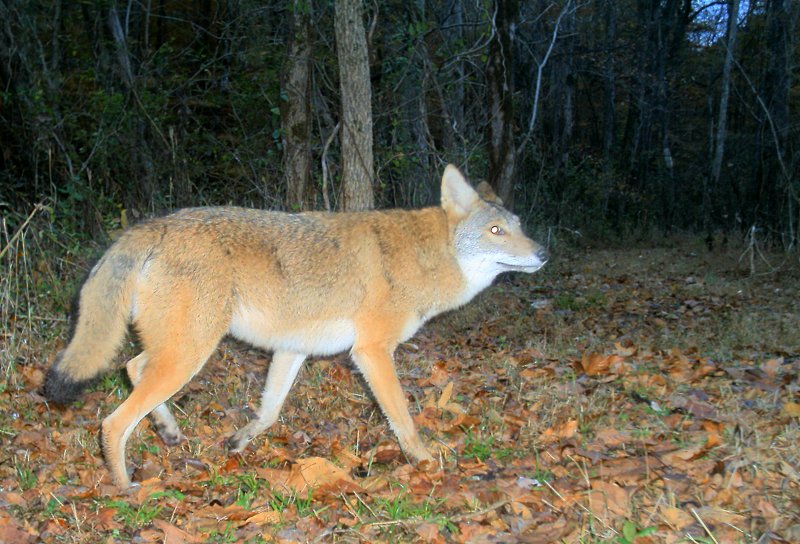
I've noticed that it does seem to be true with the breeds we've raised.


Note: Marans is both the singular and the plural form of this breed's name.

Thursday, June 30, 2005

Secret egg deposit revealed


No wonder I thought the hens had stopped laying.

My husband had put some excess hay in a big box, to get it up off the ground while he hosed down the shop porch. Then, as things tend to happen around here, it just got left there.

Somebody else (it might have been me) put some more empty boxes on top, to keep them above Jasmine-munching level. Said someone then never actually got around to moving the boxes the next week, after the near-overflowing garbage can had been emptied.

Turns out that was much more inviting than some old lovingly handbuilt nesting boxes in a super-deluxe chicken coop.

But now that someone moved the boxes that made the roof of this cubbyhole, it's apparently not so inviting anymore. They've moved the secret stash somewhere else. I haven't found it yet.

---

We've been losing critters again, I think to coyotes. One of our muscovies and several chickens. My favorite chicken. The only one we had left who was laying the green eggs. We have lots more Easter Eggers but they're still young pullets.

Leghorns start laying incredibly fast, at about four months of age. Our Ameraucanas/Easter Eggers were late bloomers, not laying until they were six to eight months old. Now that they're all gone, it'll be two to four months before we see green eggs again.

I've come to the conclusion that Jasmine thinks her job is to guard us instead of the animals. The chickens make it worse by insisting on staying in the woods, where it's cooler, but where Jasmine can't see them, and where the coyotes can pick them off with ease.