Showing posts with label travel. Show all posts

Thursday, May 15, 2008

Old soap


Earlier this spring, I attended a gardening convention held at Landmark Park in Dothan, Alabama. The old Martin Drug Store was moved there from Enterprise, and reopened four years ago. An operating pharmacy from 1898 to 1983, it's now part museum and part ice cream parlor.


You might guess which display I gravitated towards: the historical soap! None of it's for sale, alas. More of these than I'd realized are still made today: Cashmere Bouquet, Octagon, Grandpa's Pine Tar Soap, Palmer's Skin Success Soap. I'm not sure what happened to the others... soaps with charming names like Sterne's Carbolic Soap, Drexel's Wonder Soap, Flotilla Floating Bath Soap, and Packer's Charm Soap.


According to the book Boiled Peanuts and Buckeyes, the people at Martin's "were notorious for not throwing anything away and keeping meticulous records. They held onto every receipt, medicine bottle and cosmetic that ever entered the store... They had the most comprehensive collection of pharmaceutical artifacts in the nation."


I can recommend the Peach ice cream!

Monday, March 17, 2008

My favorite billboard


The devil sign is near Montgomery on I-65 north.

Just in case you didn't get the message:


Go to church or the Devil will get you!

We belong to anti-billboard Scenic Alabama, but I think this is one advertisement that everyone can appreciate.

The original sign was even more devilish. Satan was a more dynamic figure, hovering sinisterly, attached only by his scythe. Seemingly more prepared to leap and reap.

The earlier sign was damaged in a storm, I believe. You can see a picture of it here. There's also an audio story at that link -- Scott Simon speaking to the landowner, Mr. Newell, when he temporarily changed the sign during the last governor's race.

Friday, September 28, 2007

Also at Shiloh


Seen soaring above Shiloh, a beautiful Broad-winged Hawk (Buteo platypterus).

-----
Submitted to the Friday Ark.

Thursday, September 27, 2007

Shiloh, part 5

I don't remember a lot of rampant overt nationalism when I was growing up, but I guess it was there in a lot of subtle ways. Certainly at a tender age I'd been told many times by TV and books that the US was, you know, heap big #1 hot stuff.

So when I first learned about the Civil War, I didn't want to believe it. We lost a war? No way! What happened to heap big #1 hot stuff?!

Back then there was definitely a North-South us vs. them attitude that still lingered on in the minds of some of my teachers. (My husband, who grew up on military bases, was spared this instruction.) The South (that was us) had been wrong. The South (we) had been beaten.

Mostly, you outgrow it. Us/them becomes we, and the only regional distinctions nowdays usually concern accents or mannerisms, and even those differences are fading.

But the first time I saw the way soldiers were buried at Shiloh...


The Union: individual markers in a cemetery.


The Confederates: mass burial trenches. (This one contains about 700 soldiers piled 7 deep.)

I have to admit to finding in myself a pocket of that old us vs. them. Despite the fact that I know the south was wrong, and I would never defend that cause.

-----

The Union soldiers were mostly dug up from all over the battlefield to be re-enterred in this cemetery after the war (4 years after the battle). That had to have been a tough task.

-----

I had decided not to publish this post. It's a little uncomfortable to talk about, and I don't feel like I've expressed myself very well. But then I saw this bumper sticker downtown.


I have a hard time understanding what leads people to want to express sentiments like this.

Monday, September 24, 2007

Shiloh, part 4

A display at the visitor's center shows some of the items found on the battlefield over the years.


After viewing this, we imagined uncovering artifacts all over the park...


Look! A cannonball stuck in a tree! (Not really, it's a gall. We dubbed it the cannongall.)


Look! It's a soldier's tooth! (Not really, it's a bit of quartz.)


Look! It's leftover Confederate Weed-Eater string! (Not really, it's probably Union Weed-Eater string instead.)

And so on.

Another thing that occupied my brain involved wondering, "Was this tree here when the battle was fought?" The park is remarkably well-preserved. So there are trees much older than in your average neighborhood.


Large Oak tree.


Two big Water Oaks near the Visitor's center.


A largish Cedar.


Another big Oak, in the Union cemetery.

Further reading on the internet says (according to one of the park rangers) that the park's oldest trees would now be 146 - 153 years old. So some of these may have been saplings when the battle was fought.

-----

That's my sister-in-law and mother-in-law, by the way!

Thursday, September 20, 2007

Shiloh, part 3

For a former battlefield, Shiloh is extremely well organized.


Different shapes and colors on the plaques tell you at a glance the type of information, who it's about, and which day it applies to. By the way, the Union named its armies after rivers, which explains why the Army of the Tennessee is Union, not Confederate.


So, here is a positional marker for Confederate troops on the first day of the battle. If you are reading the marker, you're facing the same direction of the action. This one says:

C. S.
Cleburne's (2d) Brigade,
15th ARKANSAS, SKIRMISHERS, BATE'S 2d TENN., 24th TENN., HILL'S 5th TENN., 6th MISS., 23d TENN.,
ARMY OF THE MISSISSIPPI.
This brigade, with its regiments in order from left to right as above, attacked the enemy at 8 a.m., April 6, 1862, and was repulsed with severe loss. Being reenforced it advanced again and at 10 a.m. drove back the Union line beyond Shiloh Church. The 6th Miss. charged the position at Rhea house and lost in killed and wounded 300 out of 425 engaged.


These markers are all over the place, and they are even more interesting if you know that one of your ancestors was among the soldiers mentioned. (Mine was in the 6th Mississippi, called The Bloody Sixth because of their 75% casualty rate.)

This is also where we saw the gorgeous male Canada warbler just across the street!


Little paths through the woods lead to cannons and monuments that are scattered everywhere.


This one near the "Hornets' Nest" is for a Minnesota unit.


A detail from a Wisconsin monument. If you ever happen to be involved in making outdoor statuary, please consider not sculpting the ears to be quite so lifelike. Ms. Wisconsin had a large spider in hers, and another one we saw had been invaded by paper wasps. Ick.


Upside-down cannons mean "important personage died here". In this case, General Johnston, the highest ranking CSA officer to be killed during the war.

Wednesday, September 19, 2007

Shiloh, part 2

I learned that the reason so many people with roots in the south or midwest have an ancestor who fought at Shiloh, is that there were just so many soldiers there: 110,000.

It was one of the earliest of the larger battles (April 1862), and one of the bloodiest. In just two days there were almost 24,000 casualties (more than in all previous American wars combined).1,2

Shiloh is said to be the best preserved battlefield of the Civil War3,4.


This is where the shooting started, in Fraley Field. A Union patrol encountered advancing Confederate pickets. The whole attack was a surprise, but this engagement gave the unfortified Union camps at least a little warning.


That marker in the middle of the far field looks far away, until you think about someone standing over there shooting at you, at which point it seems a lot closer.


Replica of the Shiloh meeting house. Sherman's division was here at the beginning of the battle, and the original church was used as different headquarters on different days. (The Confederates won the first day, but the Union was reinforced overnight and won the second day.)


The peach orchard was in bloom during the battle. Petals cut by flying bullets reminded observers of falling snow. In the end there were no petals left on the trees. (These newly replanted peach trees apparently had somewhat of a deer problem.)


One end of the sunken road. (Not really so sunken anymore after 145 years.) It leads to the Hornets' Nest, a thicket where the fighting was particularly fierce.


This was called "The Bloody Pond" after so many wounded men and horses gathered there, that the water became red with their blood.

-----

1My great-great-grandfather was among them. His records are incomplete, but his wound was severe enough that he was discharged from the army less than a month after Shiloh.

2That's more than our casualties of the Revolutionary War, the War of 1812, and the Mexican-American War all put together. And Shiloh was only the worst battle up to that point. It got even worse later on.

3Shelby Foote said that. (I am obliged to make a joke about this being a Foote note.)

4Lots of people here still call it the War Between the States. A few people call it the War of Northern Aggression. If they are not kidding, those are usually the kind of people you want to watch out for.

Monday, September 17, 2007

Shiloh

We made a trip to Shiloh over the weekend. I have umpty-million photos to download, but so far this one is my favorite.


Spotted fawn in the Union cemetery. (Click to enlarge.)

His cute little fuzzy close-up:


Awww.

-----

It was a very birdy weekend. This wasn't really a birding trip, but we did have our binoculars, so we looked every time we happened to see the branches moving. The list of warblers we saw without even really trying:

Yellow-throated
Black-and-White
Magnolia
Canada
Chestnut-sided
Redstart
Pine
Palm
Brewster's (!)
Tennessee

The gorgeous male Canada warbler was a special treat since we hadn't seen one in so long. And the Brewster's, wow! They are a hybrid between the Blue-winged and Golden-winged warblers, and we'd only seen one once or twice before, at Dauphin Island.

If we'd had more time, we'd have turned it into a birding trip until the migration fallout ran dry, and finished exploring the battlefield later. The weather was beautiful - the first fall-like days of the year.


Just resting.
Eastern Bluebird (Sialia sialis).

Wednesday, August 16, 2006

St Augustine

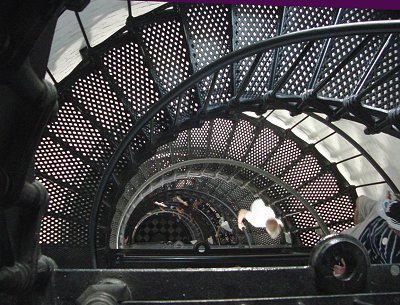
When I posted the sun photo earlier, I realized that I'd never posted the St Augustine pictures. We stopped there briefly on the way to Melbourne last month.

I paid to climb to the top of the


but I didn't get very far, because of the


so I hung around looking at the


instead.

Hubby was much braver,


and was very sweet not to make fun of me.

-----

If you're using an rss reader and the photos don't show up, they are:
1. St Augustine Lighthouse,
2. Scary see-through spiral staircase at same,
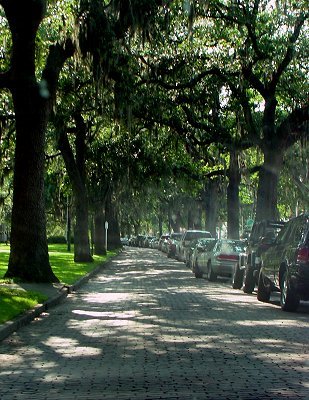
3. Soothing, calming Live Oaks (that would have been whispering, had there been any wind) and
4. View from the parapet.

-----

Actually I looked at the live oaks prior to any chickening out - they were in the parking lot. Post-chickening, I looked around at the educational exhibits, but I didn't get any photos of those.

I chatted with a park worker who told me that loads of people pay and then don't climb. Really. Happens all the time, she said. Well, yeah! See-through stairs make you dizzy.

Saturday, July 08, 2006

Melbourne


Little animals follow me everywhere.


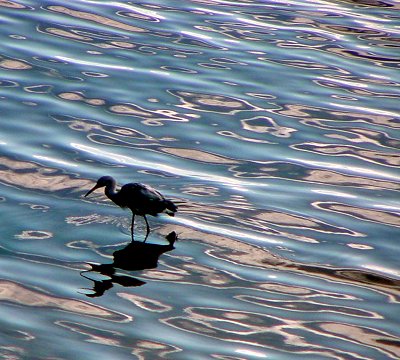
Even a bad hotel on the water has benefits... A Little Blue heron (Egretta caerulea) fishing near the shore went a long way to assuage my irritation at being refused an extra pillow.


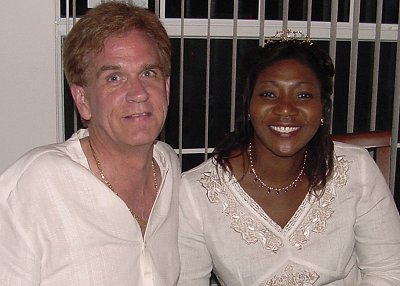
Reason for the trip.


The happy couple: Hubby's brother and our new sister-in-law.


And a very sweet new niece in the bargain.

I didn't know exactly how formal the wedding would be, and was afraid to take my camera, which is not exactly slip-into-the-purse size. Turns out it would have been fine, and I ended up wishing I'd had it. We really need to get one of those tiny ones you can take anywhere.

We drove all the way back in one day, which in retrospect may have been insane. (Any day that includes all three meals on the road is officially too much driving.) Near Talladega the dashboard light said we were nearly out of gas.

So we stopped where we normally would not, and thus were spared being on the road during some freakishly high winds that blew in out of nowhere. I retreated to the back of the store and practiced what I was going to say to the news cameras, when they came to interview me as the only survivor... "They just wouldn't come away from the windows!"

The worst part of storm eventually passed over, but we were a little shaken and had to eat some ice cream to get over it.

Thursday, July 06, 2006

Marching through Georgia

When my husband suggested that we detour and add an extra hour onto a 700-mile drive, I was not enthusiastic. But it turned out to be a good idea. From Atlanta, we followed, more or less, Sherman's March to the Sea. (Only without quite so much of a scorched-earth policy.)

And arrived in Savannah.


Spanish moss


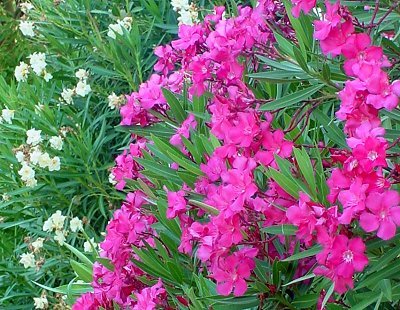
Oleanders in bloom


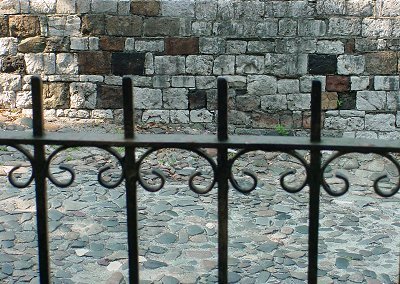
Cobblestones


Tourist boat


Waving girl


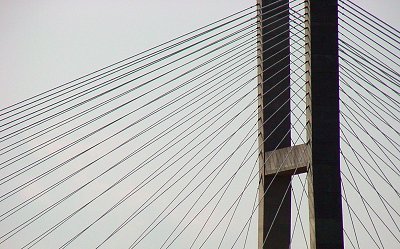
Savannah River Bridge


I think, "Colorful shop entrance."
Hubby thinks, "Copper drainpipe, you don't see that much anymore."


Giant pineapple


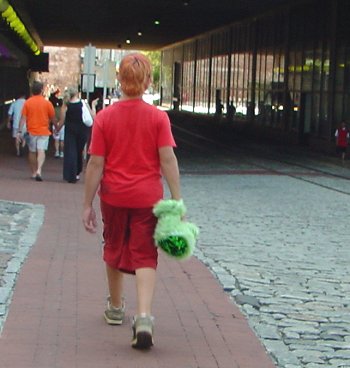
Red boy, green hat

I only wish we'd had more time there.

--------------

Near the beginning of the route we took from Atlanta, five generations and 142 years ago, one of my ancestors was captured at the Battle of Jonesborough and sent to Camp Douglas.